Showing posts with label Greenhouse gasses. Show all posts

Saturday, July 2, 2016

Obama’s Climate Policy Is a Hot Mess - WSJ

Obama’s Climate Policy Is a Hot Mess - WSJ:

Bjorn Lomborg may have been best know for his massive tomb of a book entitled The Skeptical EnvironmentalistLomborg (2007) in The Skeptical Environmentalist: Measuring the Real State of the World "may be the best source for reviewing the facts about quality of life, global
warming, and the optimal approaches for addressing the issues." (Hall, Taylor, Zapalski, & Hall, 2009, p. 5)


Apparently he has since gone off to consult for oil & gas interest. That's not all bad, but it does mean that he may not be unbiased as seemed to be the case during his Skeptical days.

Bjorn talks about, essentially, the bang for the buck ($US, in this case). The current Obama plan doesn't do much to move the global warming needle, especially given the costs. On the one hand, Obama will say that we have to start somewhere. In this case, and in several others, Bjorn simply says that this won't do much good. A smart guy like that should suggest better alternatives.

We, at SBPlan, argue that there are two monster places to start. AND neither requires the special help of government, really. Both are energy efficiency (EE) focused. Two EE business models that SBP especially likes are related to telecommuting using remote work centers and a pay-forward model
of promoting energy efficiency in all buildings – residential, commercial and
government. Since both of these initiatives save money, they offer a special win-win-win of sustainability (Employees, Employers and Environment, in this case).


I'm a little disappointing that Bjorn has been simply complaining about the expense and the likely lack of success from various government initiatives, not offering up his own recommendations. It's easy to complain and stop progress, but I give no respect to someone who does not offer up better alternatives. In the case of our non-sustainable practices of energy, the olde business as usual (BAU) model is a failed business model; it is only a matter of time for this living beyond our means model of existence will come crashing down.

Bjorn offers up more research, presumably to make renewables more affordable. And touts the Fracking-NatGas revolutions as a massive windfall for reducing our pollution and greenhouse gases away from coal. NatGas is both good and bad; it shifts us away from really dirty energy associated with coal. Yeah!:-) But it reduced the costs and availability of all oil, gas and coal such that we may have tagged on another 50 years worth of fossil fuels to global economies before we really start to run low(er) and basic economics starts to really solves our addiction to fossil fuels. 

If you read Bjorn's Skeptical Environmentalist, you will find that he totally believes that there is global warming and that man is a big (?major?) contributor. When you read this book you will agree, even before including the 10 record hot years since he published in 2007. What he does say, forcefully then, and now, is that we need to focus on the efforts that will result the move benefits. Huge government spending on reducing CO2, especially in developing countries, may have little, none, or even negative results. 

Bjorn ended up in a big tiff over the 2007 book Skeptical Environmentalist. If it was an opinion piece then it would be okay to take the liberties that he did with interpreting the results; but as a scientific book, he had gone way to far. The  Danish Committees on Scientific Dishonesty (DCSD) in Bjorn's home country, charged him with academic dishonesty in the book. This ruling went against Bjorn. On appeal the charge of scientific dishonesty was sent back for a do-over, where it stalled out.

Bjorg's follow Skeptical Environmentalist book(s) have titles that start with "Cool it!", concentrating on what to do that will likely have the most (short-term) benefits. 

Bjorg, don't just complain in op-eds about Obama and the other 200 countries who signed the Paris greenhouse deal this April (agreed to in Dec 2015). The average person reading this op-ed would think that we all should do nothing and wait for Bill Gates Foundation to find a cure. Give people real suggestions for actions. Or, are you simply trying to sell your books and consulting?

References

Hall, E., Taylor, S., Zapalski, C., & Hall, T.
(2009). Sustainability in education: Green in the facilities, but not in the
classrooms. Proceedings of the Society for Advancement of Management,
USA.
Lomborg, Bjorn. (2007). The skeptical environmentalist: Measuring the real state of the world. NY:
Cambridge University Press.

'via Blog this'

Sunday, May 25, 2014

Invest Yourself - Roaches, Never Just One

Free Investment Newsletter | Invest Yourself:

I really like what they (Robert B. Rinearsay on the currency. That all seems very very
true.  The currencies in the world are
all crap. The best may be Japan and they can’t keep the Yen low enough to be a 
competitive exporter so it is wreaking havoc on their economy…

The Yankee Dollar is a piece of crap. But we are less crappy then the
Yuan or the Euro.  We are the best house
in a slum-blighted neighborhood. 

You can only have all the currencies in the world artificially low for
so long. Especially if all the effects are compounding, year over year. I
really do think that real assets, like land and gold, will slingshot into the
stratosphere sometime rather soon, say 1 to 3 years.

But the same thing that they complain about, the talking heads at CNN,
they did themselves. Go look at any of the databases, since recorded history,
on any of the measures you chose, and you will see that the global warming is
very real, and accelerating. It also 
coincides well with populations explosion and industrialization.  And it is a compounding effect. Panicking certainly doesn't make
sense, but ignoring facts and data supporting global warming means the “hoax”
is on you.

Give a look at: https://www.skepticalscience.com/
(Real science and no crap, discussing the real facts and actual data about
Climate Change & Global Warming. It is very real by every measure that is
measurable.)
Want to know about Sustainability, look at my book (www.TinyURL.com/SustainYBook/) created
from live Wikipedia links on Sustainability. The Intro is by Elmer Hall and created the
dynamic links to carefully selected Wikipedia articles (pages). The pages in
this book represent the best, most current and most accurate single source of
information related to sustainability and climate change in the world.

Sustainability. The world currencies are not!... 
Ever growing greenhouse gas emissions,  sustainable we are not.

'via Blog this'

Wednesday, September 18, 2013

A frosty G20 puts global warming on ice - Comment - Voices - The Independent

A frosty G20 puts global warming on ice - Comment - Voices - The Independent:

Great article. Like many such meetings, the major part of the the G20 meeting gets diverted to North Korea or Egypt or Syria. Too bad, there's a lot the the G20 can do, besides putter with the politics that's taken over the news today.

Surprisingly, there was movement on making progress on the very best places to push hard related to our impact on the environment, greenhouse gases (GHGs) and global warming.

Most people who don't focus on sustainability don't realize what a wicked impact hydro fluorocarbons (HFCs) have on the (atmosphere) environment. Most HFCs are released into the atmosphere from Freon, the gas that has an ugly impact on the Ozone layer in the atmosphere. But the other problem with florine-based gasses is that they last in the atmosphere for centuries, not decades. Look at the global warming potential of various gases here: GWP at INTCCC and wikipedia GHGs.

So continuing to use Freon is a gift for the future that keeps on giving, and giving, and giving.

The approach to CFCs is one of the great success stories of our time. Starting with the Montreal Protocol in 1987 the international community has banded together to address and reduce CFCs. Most countries, that is. Progress has been especially strong because of the progress in alternative refrigerants that are still cheap and efficient. Not so much so, the progress in other greenhouse gases.


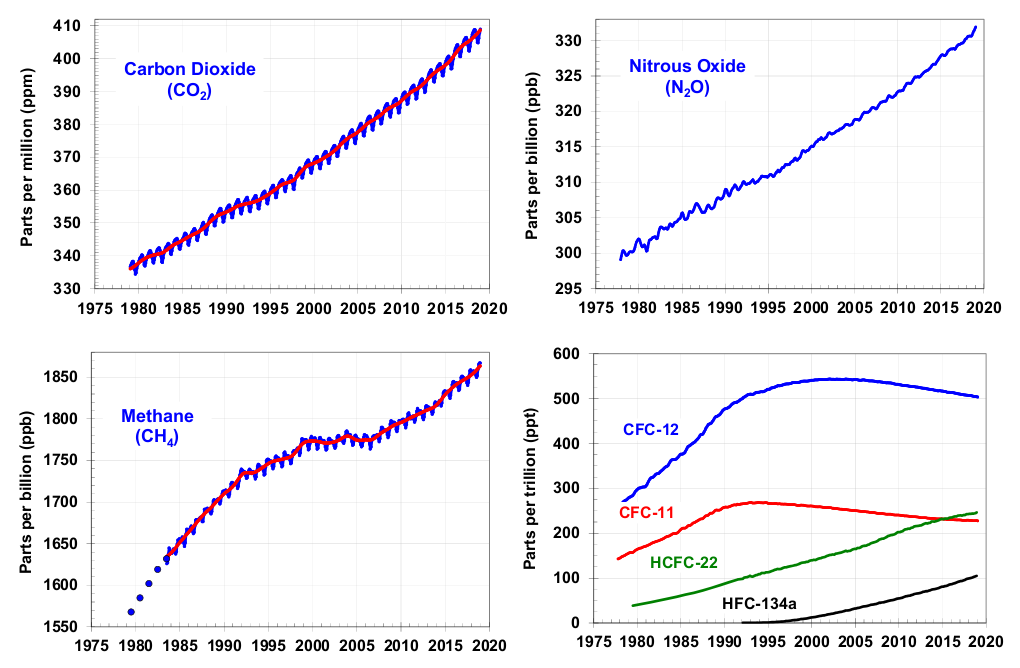
As you can see, the GHGs of carbon dioxide and the noxious oxides are increasing in the atmosphere unabated. Methane seems to be slowing down a little. Remember that these increased levels are above and beyond the levels that the atmosphere has become accustom to. Longer duration graphs are equally as telling.

But as you can see, CFC emissions have plateaued, but not necessarily reduced. The problem is that several countries, apparently, have not bothered to make the leap to replacement FREON  refrigerants, namely India and Brazil. One of the best, easiest, cheapest and greatest-impact methods to address GHG issues is to pressure those rogue countries to join the rest of the world on HFC reduction.

Turns out the G20 meeting, lead by China and USA, are looking to "encourage" these rogue countries to pick up the pace on HFCs.

Making progress on the most important things first, is a great approach to sustainability. HFCs is a great place to push. Even the G20, and the UN that don't agree on much, have taking this approach.

EE is probably the greatest place to focus, however. Energy efficiency (EE) and similar types of inefficiencies are the great untapped places to save money, energy and the environment. Everybody wins, except, maybe the power companies. But that's the focus of other books and blog posts.

'via Blog this'

Sunday, July 21, 2013

The Keeling Curve | How Much CO2 Can The Oceans Take Up?

The Keeling Curve | How Much CO2 Can The Oceans Take Up?: "Recent estimates have calculated that 26 percent of all the carbon released as CO2 from fossil fuel burning, cement manufacture, and land-use changes over the decade 2002–2011 was absorbed by the oceans. (About 28 percent went to plants and roughly 46 percent to the atmosphere.) During this time, the average annual total release of was 9.3 billion tons of carbon per year, thus on average 2.5 billion tons went into the ocean annually."

So... of the 9.3 billion in CO2 emissions, the oceans have been absorbing about 26%. But, as in all things that reach saturation, this cannot be expected to continue.

We do know that CO2 will go into the air, since the atmosphere gets first go at fossil fuel emissions. So the Greenhouse gasses might start to rise much, much faster.

This certainly looks like a no-win.

'via Blog this'

Tuesday, July 16, 2013

Sea levels set for a 'continuing rise' for generations...The Daily Climate ... Like baking a cake.

Sea levels set for a 'continuing rise' for generations — The Daily Climate:

So here's the story. It's already baked into the cake.

The current setting has sea levels rising for decades. Even if we all went to carbon neutral tomorrow.

The basics are that greenhouse gasses will persist in the atmosphere for decades, even centuries. The most prevalent is Carbon Dioxide (CO2) which will stay in the atmosphere for 70 years, maybe 100.

So, we can expect temperatures to rise 2, 3, maybe 4 or 5 degrees C. And, as the ocean waters warm, the water expands (thermal expansion). If the oceans are about 2 miles deep, on average, the heat expansion really makes a difference. We're talking yards here, not feet.

Some estimates seem to show only the top, maybe the top 10% of the oceans heating and expanding. But that's because they are using a short planning horizon. If you wait another 50 to 100 years, you should expect far more of the oceans to warm, and expand.

That is, the heating is already "baked into the cake"... Or in our case, baked into the atmosphere, which will eventually bake into the oceans, which will eventually...

Well, you get the picture.

Make no doubt, I'm looking and hoping that this scenario is not the most likely to play forward.

We do have lower solar and volcanic activities which should serve as a cooling damper for the atmosphere.

But we appear to be overshadowing that offset. At least from all I can see.

As always, the best and first place to start is conservation and efficiency.

'via Blog this'

Monday, December 3, 2012

Energy and Ecology: Comparison of global CO2 emissions estimates by GCP, IEA, BP, EDGAR, and US EIA (1990-2012)

Energy and Ecology: Comparison of global CO2 emissions estimates by GCP, IEA, BP, EDGAR, and US EIA (1990-2012):

Here is a cool chart of the estimates for global carbon emissions.

It shows the estimates from various sources and proves an interesting view as to high and low estimates.

So we are probably at about 35B tonnes per year. The increase doesn't look like it is planing off any time soon though, no matter which way you measure it.

'via Blog this'

Friday, August 17, 2012

AP IMPACT: CO2 emissions in US drop to 20-year low - Yahoo! News

AP IMPACT: CO2 emissions in US drop to 20-year low - Yahoo! News:

CO2 from the US is down. WOW!. See the full EIA report on CO2 Emissions.

The last time we had that was in 2009, we all assumed that was mainly because of the economic slowdown. But apparently, even then, part of it was because of the switching to NatGas.

"[T]he U.S. Energy Information Agency, a part of the Energy Department, said this month that energy related U.S. CO2 emissions for the first four months of this year fell to about 1992 levels. Energy emissions make up about 98 percent of the total."

So the big reasons for the CO2 emissions reduction is primarily because of the switch to NatGas from coal in energy generation! ... The slowing of economic growth down to 1.8% is another reason. 

What's amazing about this is that the switch to natgas is primarily driven by market forces. The power industry has been wining endlessly about the big food of the EPA on the juggler veins of the power industry... and of course the US economy. Yet, the move happened way ahead of schedule. 

Low prices of nat gas make it, well, irresponsible, not to switch to clean gas away from dirty coal.

Health benefits (fewer deaths and injuries in mining). Massive improvement in air and water quality. No coal ash to deal with.

This would all be a good thing, if it weren't for the massive increase in coal consumption from China and India. Where, exactly, is the benefit of us cutting back on coal when we simply ship it to China and they burn it. And they don't worry about scrubbing it as much as we.

China now burns half the coal in the world, and rising quickly.

Sorry for looking good news in the eye and sounding skeptical. We sometimes simply need a little good news here and there and just to enjoy it.

Ahhhh, NatGas, A cleaner addiction to a unsustainable problem.

'via Blog this'