YOU Q: Please generate an outline improved from the one attached that includes hyperlinks to each topic. Where appropriate include links to quality Wikipedia articles. Also, please utilize the WikiBook outline with Wikipedia hyper links by Hall from: https://www.sustainzine.com/p/sust-wikibook-links.html
This is a sustainability-oriented blog. Topics pertaining Energy Efficiency (EE), Telecommuting, Sustainable Health/Wellness, etc., but mainly focus on solutions to non-sustainable practices and trying to address means and methods for resolving them. Sustainability is something that we all have to do, sooner or later! (Low politico please!).
Friday, March 22, 2024
Update to Sustainability WikiBook (Using the power of Generative AI)
Friday, April 10, 2020
SolarInvest2020: Residential Quick Take on Doing Good
![]() |
| Residential Solar can be a good investment. Good Savings. |
SolarInvest2020: Solar Profitability Calculations: Residential and Commercial
As people hunker down at home, and spend time doing all those fix-up items that have been waiting for years, they should also consider working through the details of adding solar.
First, of course, do those energy efficiency tricks that cost very little: smart thermostats, caulk windows and cracks, and improve your insulation. Your favorite power company will do an energy audit so you can get a check list of things to do. The typical building can save 15% to 25% on simple and cheap energy savings. Monitor usage, because the biggest culprit may be humans with bad energy usage habits. Insulation in the attic could have a 3 to 4 year payback and reduce your electric bill by 15 to 25%. Now with the lower energy usage, you should consider adding Solar.
[UPDATE: 30% Investment Tax Credit on renewables in the IRA Act 2022. See our Blog post here. This makes all the financial discussions below much more profitable. Also, higher inflation and higher power inflation.]
Solar can be a Good investment in many cases, like Residential. But it can be a Crazy Profitable investment for Businesses. The renewable investment tax credits (ITCs) drop down again at the end of 2020, so now is a great time to think about it.*
![]() |
| Residential Solar |
- Quick Take on Residential Solar: Solar Invest 2020: Do Good and Save Money Too
- Full Financial Analysis: SolarInvest2020: Residential Solar is Good, but Commercial Solar can be Crazy Profitable!
![]() |
| Commercial |
About BizMan (Elmer Hall) & Strategic Business Planning Company. Elmer Hall has a Doctorate in International Business Administration and is an adjunct Professor of Business. He is President of Strategic Business Planning Company, a company that does business plans, especially plans that focus on intellectual property and sustainability. Look for Hall’s Perpetual Innovation™ line of books for innovators and inventors. Website: SBPlan.com Blog: SustainZine.com
Friday, March 27, 2020
Solar 2020 and Sustainability: Looking for the Silver Lining
Kelly Pickerel, Editor in Chief of Solar Power World
magazine was cautiously optimistic in January when discussing the impact of US
Import tariffs on the Solar industry and still solar installations were up 14%
during 2019. Wow! Nobody could have envisioned the coronavirus pandemic and its impact on all industries including solar. But, the environment is taking a breather: Environment Wins with Reduced Human Activity.
Wednesday, May 30, 2018
Solar Fit 052618 by flaglerbroadcasting Elmer Hall with Bill Gallagher EE & Telework
Folks,
- EE in buildings. Our estimates are that the savings from energy efficiency in buildings
could save about $300B in the US each year with the “change in your pocket” (things like programable thermostats, LEDs, smart meters, caulk and duct tape), i.e., stuff that has a payback immediately or within one year. (See Alliance to Save Energy for great tips.) For new construction, a greener building can have 80% lower operating costs and be healthier, while costing within 10% of more traditional construction costs.
EE TIP. Do an energy audit – usually provided by your local power company (frequently for free) – to evaluate current usage and best places
to start conserving energy.
EE TIP2. First take your energy use down through energy efficiency, thereby reducing dramatically the energy requirements when evaluating the next steps toward a zero-carbon footprint like solar, wind and geothermal. - Remote Work Center for telework. At Strategic Business Planning Company, we have done a lot of work related to the concept of telecommuting and providing workers the easy ability to work from home or from a work-center that is very close to home. Based on Lister and Harnish
numbers from 2010, we estimate the total savings from just 10% of the commuters who drive along to teleworking would result in about $357B in savings per year (113M x 10% = 11.3M * $31,600 = $357B). In 3 years, that would be more than $1.1T in savings. Or, with 30% of the drive-alones switching to telecommuting, that would be $1.1T in savings each, and every, year. That is a perpetuity of savings. (At 5% interest, a perpetuity of $1.1T represents $21.4T net
present value terms – more than the entire annual US Gross Domestic Product in 2018.)
Telework TIP. Selectively pilot teleworking from home and log the time, distance, and productivity.
- Smart Savings and disposable Income. Savings of energy, say $100, is worth much more than the equivalent of income. An individual would need 30% to 50% more in salary (say $130 in gross income or $150 dollars for the employer) to equate to the same amount of disposable income. For a business with 10% net income, it would require about $1,000 increase in sales to equate to $100 increase in disposable cash. This is a perpetuity of savings (or a commitment to the increased sales indefinitely).
$TIP. Log the results and put the savings into a separate account or fund. The $100 per month that would have gone to utilities could, for example, be automatically posted to an IRA account, potentially amplifying it by your tax rate. Or, use the savings to help pay for a Solar PV system.
$TIP2. The 30% Federal Tax credit for energy efficiency for individuals makes the investment in new energy efficient appliances and renewable energy very attractive, usually with a 3- to 9-year payback (and life-time present value is often double your investment).
commuters should be able to telework once a week or more. This utilizes current technology and does not require any government “help”.
credits (like in California) or utilized by the company for its own internal costing structure in Corporate Social Responsibility reporting.
on drive-alone commuters (and include costs that are reasonable, but not included in the 2010 Lister study). The environmental savings are less than $2,000 per telecommuter by Lister, but we estimate that number could be much higher, like $5,000 to $10,000, when considering the big externality costs.
Patents, the great equalizer of our time! An overview of intellectual property
for inventors and entrepreneurs. Morrisville, NC: LuLu Press. ISBN:
978-1-387-07026-8 Retrieved from: http://www.lulu.com/spotlight/SBPlan [Amazon v4.0e ASIN: B074JJCDHG Retrieved from: http://www.amazon.com/dp/B074JJCDHG ]
Specific Radio Show of Elmer Hall: https://soundcloud.com/flaglerbroadcasting/solar-fit-052618
The radio show archives: https://solar-fit.com/solar-fit-renewable-energy-show/
'via Blog this'
Wednesday, May 9, 2018
California Becomes First State to Mandate Solar on New Homes - Bloomberg
California is 1/3 of the US economy and probably 1/3 of the US housing market. So, when California voted today to have mandatory solar on most new construction houses, this blows the top off of the non-solar rooftop.
Headlines read that the CA house will now cost about an additional $10,000 to build with the energy efficiency and solar roof mandates. This Bloomberg article says that the savings will be about twice the increase in building costs.
True, it costs more to build, but the operating costs are dramatically less.
This is related to new houses, so the decision is easier than for an existing house.
However, that decision should be really simple as well for a house with good sun exposure. There are tax credits and ways to finance that will allow the homeowner to pay for the solar system out of the savings in power, until the whole solar system is paid off in 15-20 years and then it is a perpetuity of savings!...
So, a $40,000 system in Florida is $28,000 after a 30% federal tax credit. The payment on the loan would be equal to, or less than the payments for electricity, on average. And, after you pay off the system in, say, 15 years, you have about $250 worth of net savings per month for a long, long time. That's $3,000 per year in year 15; as a perpetuity, at 5% interest, the net present value is about $29,000 positive.
Wait a minute. That is more, net present value-wise, then the entire out-of-pocket cost of the system if you had paid cash up front (less the tax credit). But you may not have paid any cash up front for it and paid all loan/lease payments from the savings on the electric bill!
So, if the same math applies for a $300,000 home in California (cause everything's far more expensive in California), which is now increased to $310,000. The additionally $10k can be separately financed; probably, with terms of nothing down and loan payments that are less than the electric bill. That is, from day one, the cash flows from operations are as good or better than paying full electric bills.
Once you pay off the PV loan, you now have free electricity, for a long time.
Plus, it is good for the environment and reduces CO2 emissions, and significantly reduces the reliance on centralized energy production form your favorite power utility.
The net present value of the cash flows may be $10-$20,000 positive.
A couple important factors: Power companies have traditionally increased costs by more than the level of inflation (inflation at about 2% and rising). Inflation and interest rates should rise significantly with full employment. PV technology reduces very slightly over time (0.5% per year).
The private PV power system protects against the rising costs of power.
....
So, the headlines might more accurately read:
New CA Solar Mandate will increase home costs by about $10,000 but offset by about twice from the reduced of operating costs.
Another win, win, win of sustainability.
This should not be a hard decision to make, in any sunny state. The mandate should not be necessary. Consumers should be making this decision as a smart decision, not just a green decision.
Being Green, and making Green too.
'via Blog this'
Thursday, September 1, 2016
ipZine: The world's first super light folding electric bike | YikeBike
This posted over at ipZine. ( The world's first super light folding electric bike | YikeBike: )
Even cooler than the Segway, and multiple times as functional.
Give a look at this YikeBike. When you see this bike, you will say Yikes!
It is reminisce of the old High Wheeler bikes with the monster wheel in front, and no gears (1-speed). But with a twist.
The question to ask is this new bike a true invention? Is it innovation? Or is it both?
It won the Time Magazine's intention of the year in 2009. Finalist in Nobel's Prize for Sustainability.
Part of that question might be answered by how many patents the technology harbors.
The main international PCT patent (2008-2009) has been filed in about 8 countries and does not appear to be issued yet. There are other interesting patent technologies integrated into the design. Here's the main patent WO2010007516A1 from the EPO.
It seems like a great alternative to the idea of our usual approach to jump into our SUV and drive a few streets to work or for a latte -- 180 pound person being transported by a 2,000 vehicle using a 300-400 horse power motor.
This idea seems to solve several problems with the bike as a mode of transportation, some problems that we never really knew we had.
When you look at the product, you will wonder where the motor and the batteries hide.
How does it keep from falling over in 3 different directions?
What is a "farthing" and how can it possibly be considered a great selling point? Even if you call it a "mini-farthing". Do we really need a secondary axis, orthogonal to the primary axis?
Can you take your YikeBike on your man bike (Harley) without being called out for having a "girlie-man bike"?
Where can you get a YikeBike? Apparently, they have free international shipping.
YikeBike comes with "the freedom to park wherever I DAMN please!"
Will people say, "Wow", "Cool" and "hip", or will they say:
"Yikes!"???
Translation to English: The Carbon Fiber Model C weighs 25 lbs. goes about 14 mph max with a range of 12 miles. The model V weighs 30lbs (or 34 for the 3-wheeled V version).
Colour means Color in English and pictures pretty much speak for themselves without translation. Bet they even drive on the wrong side of the road?!
Friday, January 22, 2016
2015 hottest year, by a mile
Ouch, ouch and double ouch!.
This was a wicked El Nino year. Only an El Nino year last century competes with the hottest 14 years this century. Apparently, the follow through from El Nino starting in 2015 should leave 2016 as a rather hot year.
One of the best summations on the subject came from NPR. Or Global Warming in Wikipedia, where you will find the best, most current, information on sustainability in the world.
Starting in 2014, we had half of the months as record hottest months. 2015 had most of the months being the hottest on record; 10 months in 2015 matched or exceeded all time recorded history records! (Ask when we last had a record COLD year, or even a record COLD month, and you will get goose bumps!)
Fortunately -- finally -- most of the people in the US are finally coming around to the fact the we do, in fact, have global warming. See blog here.
As CO2 blasted past 400 ppm in 2015, we have only just begun this journey into uncharted territory. And, CO2 can be expected to persist in the atmosphere for about 100 years.
It took the earth 50 to 500 million years to store up the coal and oil we seem determined to burn up in about 2 centuries. And in the process we are releasing mass quantities of carbon into earth's ecosystem that has been happily sequestered, like diamonds in the rough, for 100 million years or more.
We at SustainZine, propose actions that we all could take immediately. Within a day or so, we all could have taken energy efficiency actions on our homes, businesses and churches. Wa-la... Save energy, save money, save the environment (a little for each of us). A perpetuity of savings.
Telecommuting/telework is a wonderful place to start with businesses. Huge savings of energy, time and life. A perpetuity of savings if the non-drive to work, continues to work.
And there are many things like this that we can do without the "help" of government.
Education, likewise, is critical for us all to start making more informed decisions. There are easy things that we all should be doing, right here, right now. We also need to be continually aware of the BIG factors, so that they are in the forefront of our future decisions and actions.
Business as usual is something we need to continually question. That's what got us into this situation. Unconscious decisions are still decisions.
A business without a sustainability plan, does not really have a business plan.
2016 seems like a year when sustainability will start to gain firm footing in the US. Each of us can start by save a watt and save a gallon.
Thursday, August 13, 2015
Cree Likes its LEDs... Helps colleges and others save lots of money & energy.
San Diego Community College District is the recipient of the APPA’s 2015 Sustainability Award recognizing and advancing sustainability excellence in educational facilities. An CREE want a little school credit. The upgrades used Cree® LED lighting upgrade with SmartCast® Technology.
Looks good.
In the meanwhile, Ikea stores are moving to only selling LED lights by 2016. Read here about Idea's LED ideas. They argue that about 20% of electric energy use in the world comes from lighting. So if LED lights can reduce that by about 85%. That is a BIG Woo Hoo for the environment too. The savings of energy/electricity are really only a small part of the savings. Other lights produce huge amounts of heat, which generally increase air conditioning costs. It takes time and money to buy replacement bulbs, install the new and dispose of the old. The costs to a business are huge. Whereas the LED light will not be replaced in many of our lifetimes.
LED lights now have much better light quality, and many are dim-able.
Oh. And if you love CREE's products and services, be careful buying the stock of the company. Even with all their patents and proprietary technologies, this is an overly competitive market.
Very cool.
'via Blog this'
Monday, June 22, 2015
Growth is always good? No matter the costs!
Saving can be hugely benefiting to all. But it doesn't show up in increased sales and higher GDP.
A bigger, newer SUV is always better...
Hmmmm?
http://www.theguardian.com/sustainable-business/2015/jun/10/good-natural-malignant-five-ways-people-frame-economic-growth?CMP=share_btn_tw
Tuesday, April 7, 2015
Climate-change deniers are in retreat - The Washington Post
It will be nice to move past the non-debate about is there global warming, and move off into the real debate.
We are all living unsustainable lives with non-sustainable business models. What is our plan to move toward sustainability. Singly and collectively?
The argument that it doesn't do any good for us to do something if China and India continue consuming is sad and ironic.
For a century, we in the US with only 4.5% of the worlds population, have consumed about 1/4 of all the worlds resources consumed/used... Coal, Iron, Gas, etc.
We have produced about 1/4 of the worlds byproducts for a century (pollution and CO2).
We at this blog like to focus on those things that can be done within weeks, not decades. Energy Efficiency (EE) initiatives can pay for themselves in weeks, with a perpetuity of savings forever after. Telecommuting can result in a perpetuity of savings for ever (until you start a new job that requires a commuting).
We argue that nobody anywhere can reasonably believe that the price we pay at the pump of oil and at the meter for coal power is accurate and represents the true cost. Gas taxes continue to pay less and less of the US road maintenance, for example.
Economist generally settle on a carbon tax as a better solution than either subsidizing green energy/cars or a cap-and-trade mechanism. There will never be a better time to initiate a carbon tax then 2014 when oil prices are half and should be reasonably low for a year or more.
Or, we can continue to consume oil and gas like as if there is no tomorrow.
'via Blog this'
Friday, December 12, 2014
Energy Efficiency & Renewables... Good signs for both.
From Cavanagh, peaked energy use occurred in the US in 2007 and has trended downward since with a small increase in 2013. And, economic growth is increasing more rapidly than the growth in energy usage because technology is making energy sources more efficient. The LED light bulb is a good example. Improvements over the last 40 years have done more to meet US energy needs than the combined contributions of oil, coal, natural gas and nuclear power.
Electricity consumption has decreased since 2000 despite the introduction of new consumer electronics. Moreover, oil consumption by homes, businesses and vehicles is down 12% since the peak in 2005. June, 2013, began a 12-month period in which the combined usage of renewables exceeded hydroelectric power. More than 12% of our energy supplied comes from renewables and that category is growing faster than the others.
In her article, Cardwell confirms that the cost of providing electricity from wind and solar has dropped significantly in the last five years, so much so that in some markets renewable generation is now cheaper than coal or natural gas. Several utility companies in the Great Plains and Southwest where wind and sunlight are abundant have signed power purchase contracts, known as "power purchase agreements," for solar and wind at prices below that of natural gas.
According to Lazard, an investment banking firm, the cost of utility-scale solar energy is 5.6 cents/kwh with wind as low as 1.4 cents/kwh. Without federal subsidies that are up for renewal by Congress in 2016, solar costs are about 7.2 cents/kwh and wind would be 3.7 cents/kwh. Natural gas is at 6.1 cents/kwh on the low end and coal is at 6.6 cents.
Both renewables and fossils have limitations. For renewables, the wind has to blow and the sun has to shine as electrical storage technology needs a break through. For the fossils, there are regulations and costs due to carbon emissions pollution. One can expect this hybridization of fossils and renewables to continue for a considerable period of time.
Minor edits: 12/17/2014.
Monday, March 10, 2014
Day Light Savings Time... And Energy Efficiency... and Sustainability
Give a look at the past blog post here on EE and DST and California's discussion about Daylight Savings Time.
This is the heart of sustainability: things that we can do right here, right now, to move toward more sustainability. Some of them might be only small changes, like adjusting the clock to start earlier in the day, when sun gets up earlier...
One other idea is to move to LED lights. If 10% of our utilites comes from lighting, and LEDs will save us about 70%.... That cuts about 7% of our electric production. if utilities are about 2.5% of our $16.15T GDP... That's $28B per year. Every year. As a perpetuity at 5% interest that would be a half trillion dollars ($565B). These are rough numbers, but the concept holds up nicely.
| GDP | Factor | $16.15 | T |
| $ Energy | 2.50% | $ 403.75 | B |
| % Lights | 10% | $ 40.38 | B |
| Savings | 70% | $ 28.26 | B |
| Perpetuity | 5% | $ 565.25 | B |
Friday, January 10, 2014
The Energy Quiz | ExxonMobil
Try the energy Quiz from ExxonMobil: exxonmobil.com/quiz
It has 4 categories related to energy: people, sources, uses and savings. There are 5 questions in each section.
Interesting that the actual quiz lives here: http://corporate.exxonmobil.com/en/company/advertising-campaigns/energy-lives-here/quiz
Under the advertising campaign.
I didn't do well on the quiz. And you probably won't either. I do take issue with at least one of the 5 questions in each category. I don't like how they state projections as fact. (Make sure not to over think it.)
BUT this is a very cool quiz and provides very nice information for people to think about.
'via Blog this'
Wednesday, November 27, 2013
Dell Wants Employees To Work From Home - Business Insider
Dell is following a "Do Good" plan for 2020. Remote work, packaging and shipping. Working with supply chain and customers as well. Looks pretty GOOD!:-)
As it pertains to telecommuting... Dell seems to be saving a lot and doing "Good" as well. Telecommuting and other initiatives are outlined in Dell 2020 Legacy of Good Plan.
Here's a calc and additional info on Telecommuting savings: http://www.globalworkplaceanalytics.com/calculator
So Dell is saving lots of money. $14m last year, and reducing impact on the environment, including almost 7 thousands barrels of oil/gas reduction.
Sounds like a Good Plan, pun intended.:-)
'via Blog this'
Wednesday, September 18, 2013
A frosty G20 puts global warming on ice - Comment - Voices - The Independent
Great article. Like many such meetings, the major part of the the G20 meeting gets diverted to North Korea or Egypt or Syria. Too bad, there's a lot the the G20 can do, besides putter with the politics that's taken over the news today.
Surprisingly, there was movement on making progress on the very best places to push hard related to our impact on the environment, greenhouse gases (GHGs) and global warming.
Most people who don't focus on sustainability don't realize what a wicked impact hydro fluorocarbons (HFCs) have on the (atmosphere) environment. Most HFCs are released into the atmosphere from Freon, the gas that has an ugly impact on the Ozone layer in the atmosphere. But the other problem with florine-based gasses is that they last in the atmosphere for centuries, not decades. Look at the global warming potential of various gases here: GWP at INTCCC and wikipedia GHGs.
So continuing to use Freon is a gift for the future that keeps on giving, and giving, and giving.
The approach to CFCs is one of the great success stories of our time. Starting with the Montreal Protocol in 1987 the international community has banded together to address and reduce CFCs. Most countries, that is. Progress has been especially strong because of the progress in alternative refrigerants that are still cheap and efficient. Not so much so, the progress in other greenhouse gases.
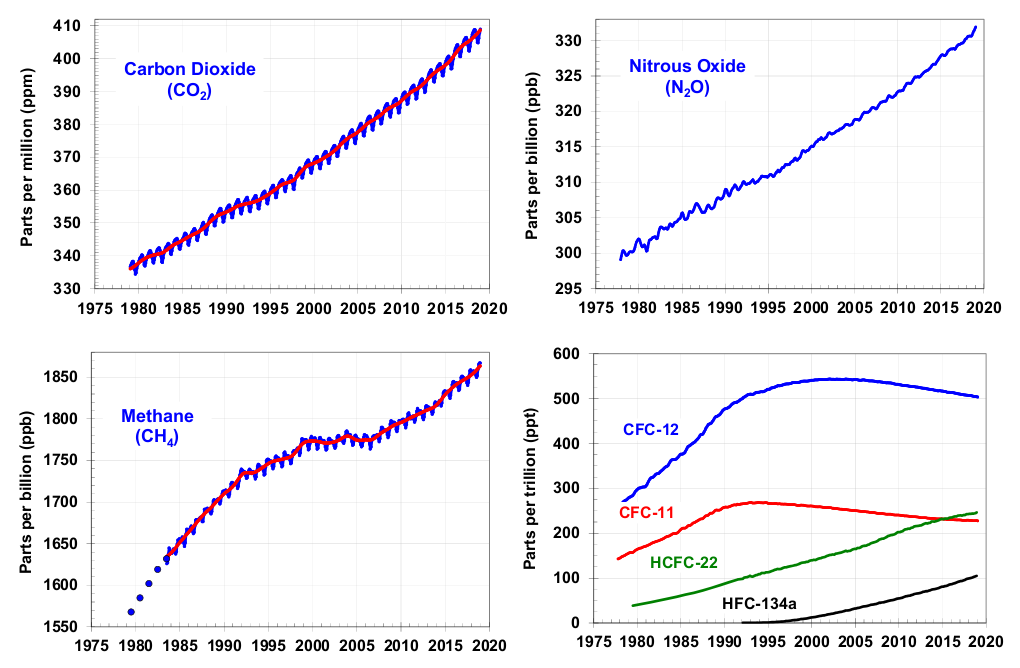
As you can see, the GHGs of carbon dioxide and the noxious oxides are increasing in the atmosphere unabated. Methane seems to be slowing down a little. Remember that these increased levels are above and beyond the levels that the atmosphere has become accustom to. Longer duration graphs are equally as telling.
But as you can see, CFC emissions have plateaued, but not necessarily reduced. The problem is that several countries, apparently, have not bothered to make the leap to replacement FREON refrigerants, namely India and Brazil. One of the best, easiest, cheapest and greatest-impact methods to address GHG issues is to pressure those rogue countries to join the rest of the world on HFC reduction.
Turns out the G20 meeting, lead by China and USA, are looking to "encourage" these rogue countries to pick up the pace on HFCs.
Making progress on the most important things first, is a great approach to sustainability. HFCs is a great place to push. Even the G20, and the UN that don't agree on much, have taking this approach.
EE is probably the greatest place to focus, however. Energy efficiency (EE) and similar types of inefficiencies are the great untapped places to save money, energy and the environment. Everybody wins, except, maybe the power companies. But that's the focus of other books and blog posts.
'via Blog this'
Thursday, August 15, 2013
Why the World Bank Is Taking On Climate Change - NationalJournal.com
Caral Davenport of the National Journal spoke with Rachel Kyte, the World Bank's vice president of sustainable development, about the economic impact of climate change.
The world bank is taking some rather aggressive action.
(Also watch the debate on global warming that follows. Hmmm?.)
Some of us would argue, that if you don't want governments to take more active roles in sustainability, then we all should start to be more sustainable ourselves. We have to eventually, right?
Why not start now, and start with the "low lying fruit": energy efficiency, telecommuting, etc. Those initiatives not only pay for themselves, but can be implemented immediately.
Or we can continue to debate if there really is global warming, is it primarily man-made, etc.
For the latest info on the science and the concepts of sustainability visit: www.TinyURL.com/SharedStuffZ/
The intro document there provides the outline of the WikiBook with hyperlinks to the live pages in Wikipedia. If you think that Wikipedia is wrong, please offer corrections and provide sources and links to the proof. But, before you offer corrections, read some of the section, especially read the nexus of energy, water, and food.
Even if there were no global warming, we all should start to take aggressive action now, today, ahora. The global warming issue simply adds a level of urgency to our steps.
'via Blog this'
Sunday, July 21, 2013
US energy use dropped in 2012 as renewables, natural gas rose | Ars Technica
Yes, the US has backed off a little with energy use during the recession, especially.
That would be a good thing if not for the emissions from China and India.
This is an AMAZING chart of the energy in and the energy out within the USofA. This has been an interesting chart to watch over the years.
~95.1 Quads
That is Quadrillion BTUs. (British Thermal Unit). If you think a Quadrillion is a LOT, you are right.
Double interesting in this picture is the the "rejected energy". That is 58.1, estimated to be the same as that used. Therefore the right side is about 116.2 (58.1 + 58.1). I guess the left side is the 95.1
It takes some time to fully understand this diag, over time it is very interesting.
Note the drop in Coal in the US. Nat gas is so clean and cheap it is likely to put coal out of business. In the USA anyway.
We'll send it to China? By now China must have exceeded half of the worlds coal consumption.
Want to look at forecasts of the future, go to US Energy Information Administration Annual Energy Outlook 2013.
'via Blog this'
Wednesday, February 13, 2013
Pres Obama steps out to wave down the run-a-way climate train!
Check out this post by Peterman at Huffington:
http://www.huffingtonpost.com/keith-peterman/state-of-the-union_b_2674448.html
Many environmentalists are going to complain that this is not enough, but it really is better to start late than even much much later.
As Peterman shows, it looks like we are aiming for 6+ degrees C, not the 2+C that many people were hoping to achieve. At that rate, sea-level rise would be measured in yards, not feet.
Not much on details. Federal government can take some action for government buildings and transportation,
Reduce energy consumption by 50% in 20 years should be, surprisingly, far easier than most people think. 25-30% could be achieved in buildings within a couple years, with a payback of months... And a gigantic Return on investment.
Easier said then done, though.
But to continue doing "business as usual" would be, well, irresponsible.
Friday, August 3, 2012
"Humans Are Almost Entirely The Cause Of Climate Change" Richard Muller Former Climate Change Denier - YouTube
This is a very interesting video/news from MoxNews.
The Exxon Valdez has an oil spill, has a name change, has a name change, has a shipwreck, has a name change, and is now being dismantled/retired. The wreck, by any other name, is still Valdez.
NatGas +/- . . . Not so sure about the Frac'ng story... But hang in there til the end. It is well worth the wait. If it has equal likes and dislikes, then it is probably pretty good!
Richard A. Muller, the last hold out of global warming, has now come out with a book. Once you remove the noise, the level of CO2 matches perfectly with global warming. It is important to know that humans are the cause, probably the primary cause, of global warming. This is good, kind of. "If we cause it, then there's something we can do about it." He didn't think solar variations, volcanic eruptions, el nino, etc., had longer term impacts. "The carbon dioxide curve was right on."
Muller won the MacArthur Genius Grant 30 years ago. He was the last major skeptic on Global Warming. He just completed major research on global warming funded by the Koch Foundation, a ?conservative? group by the Charles G. Koch family, the oil billionair family. Anyone knowing about the funding source, would have been surprised about the results.
He found last year that Global Warming is real.
He now has determined that human activity seems to be the predominant cause. The rise in CO2 matches perfectly with the rise in temperatures. Correlation is not causation, but the correlation is very strong.
Global economic shock to cut back on CO2 emissions? Energy efficiency. And switch away from coal. He suggests NatGas as immediate switch away from coal. NatGas produces 1/3 the level of CO2 as coal. (I'm not so sure about 1/3, I think it is 33% less CO2 than coal per energy equivolent.)
The big thing is that the controversy of Global warming is dead. It's a fact. It appears to be perfectly correlated with human factors that generate greenhouse gases (eCO2). So the next debate (or controversy, maybe) is what are we gonna do about it.???
New version of his book:
'via Blog this'